
Average Increase in Earth Climate

Climate Change: Where are we heading with a 1.5 to 2 degree C warmer planet?

Scientists recently predicted that a change of 1.5 to 2 degree C can be a huge warning in the direction of climate change for this planet. Have you ever wondered why a change of ~2 degree C can be a big deal? Well the outside temperature changes by more than this difference almost every season? Where does the difference lie? Here are some points for people to clearly understand the nuances of climate change more clearly. All credit goes to the wealth of information provided by commenters on the subreddit page ELi5.

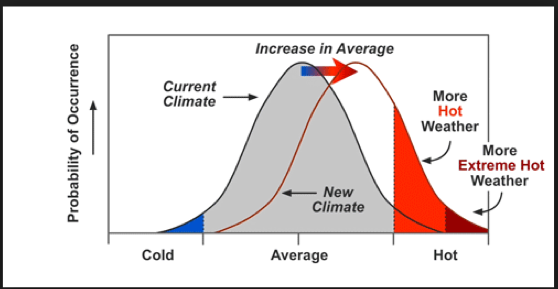
  1. Average global temperature isn’t the local weather outside, nor is it the weather on a particular day (weather is local, climate is global). It is the average weather for the year across the globe. Unfortunately, this obscures the fact that the temperature change is dramatically uneven across the world, making it seem like a relatively mild climate shift. It’s more about the change in extremes which are getting further and further apart. Range of temperatures is getting bigger by just implying a 2 degree average temp change. This also mean bigger temperature and pressure gradients. Scientists use average temperature because if we have to specify extreme temperatures, then time and location will also have to be provided, which is difficult. It is easier to give an average value for laymen terms. Most things can handle 2 degree warmer local weather since that happens every day, sometimes even from morning to afternoon. Many things can’t handle 2 degree warmer average global weather. They are not the same. Here is an XKCD link explaining that the average global temp during the ice age 22,000 years ago (when the earth was frozen over) was just 4 degrees C less than what it is today. The “little ice age” was just ~1-2 degree colder than today. Therefore, each degree in average global temp is substantial. One more explanation is to think about the temperature in your freezer going from 32 to 33F. Still cold, but all the food will spoil. Or the temp difference between frozen ice and liquid water is less than a degree. This means that if the average temperature over an area was below freezing, then with a 2 degree increase, that area is above freezing. We also know that 37 degree F is human body temp, but at 39F, we are ill and 41F is mortal danger. Think about this!
    Average Increase in Earth Climate

    Average Increase in Earth Climate (Source)

  2. Earth is a giant thermodynamic engine that takes in energy in higher amounts near the equator where solar gain is greater than heat radiated back in space and funnels it to the poles where solar gain is less than heat radiated to space. CO2 acts like a blanket over the system, taking more heat in. But the fact is, equatorial zones don’t heat much, they just shuttle extra heat to the poles through oceans and wind currents. Same air currents also transfer the CO2 to the poles as can be seen in this NASA model, which further reduces the heat radiated back into space at the poles. This means that the poles are heating up a lot more than 2 degree C, but more like 10 degree C. Resulting melting ice will raise sea levels costing trillions of dollars to either pre-emptively try to deal with or as flood damage. Also ice is the most reflective thing in nature and a large part of our planet is covered in it. This reflects heat back into space. As it melts, it exposes dirt water, the least reflective thing, and it absorbs heat, making the problem worse. Raising temperatures also make permafrost melt which exposes methane pockets that ends up going into the atmosphere. As a result, more permafrost melts and the cycle continues. Methane hydrates also gets sequestered in the ocean and is considered to be a 84 times more potent greenhouse gas than CO2.
PopulationProjection

Population living on land exposed to inundation by 2100  

  1. Salty and colder water in oceans near poles is denser which actually forms ocean currents as it migrates to ocean bed and travels to land and so on. With poles melting, fresh water in oceans will lead to the death of ocean currents.
  2. Last ice age had a ~5 degree C lower average temp than now and the end of all mammals will be around +6 degree C. On that scale, 2 degree C is quite a movement.
  3. Also think about the time it takes to heat up a full pot of water versus a little. Earth is mostly water and if it is heating then it means a large portion of energy is being entered in the system. This does not just heats water but also changes everything else in the ecosystem.
  4. CO2 also gets absorbed in the oceans. As rising CO2 levels acidify the oceans, due to the creation of carbonic acid (same acid in soda), organisms with calcium carbonate shells like shellfish and coral grow slower and will likely soon reach the point where their structures will dissolve faster than they grow. This will kick the leg out of the base of the oceans food web and will largely collapse ocean life in near shore areas with the exception of algae and jellyfish. Phytoplanktons are also affected by acidity, and they produce about two thirds of the oxygen we breathe. Intense use of artificial fertilizers makes this problem worse in oceans. Extreme weather changes, coastal cities being flooded, damage to plants, insects, and sea life, and ocean acidity will be the first effects. Mammals can regulate heat better, and humans can adapt. However, the impact on other living beings will imbalance the whole food chain, making species go extinct or struggle to adapt when they otherwise could have manage efficiently. Eventually, it all comes back to humans as we are at the top of the food chain, and will be struggling to maintain our current farming crop yields (as plants would be affected).
  5. Our beaches are almost 100% made up of CaCO3. So if oceans become more acidic, then the beaches will also be affected over a period of time.
  6. Change in global average (not 2 degree local) can also make some currents very hot but highly populated areas uninhabitable. On the flip side, some currently icy areas can become habitable, though there is no guarantee that they will be fertile. Earth has started to shift out of equilibrium. We are getting high pressure systems that park themselves over an area for weeks. In the ocean, this can kill corals (which is already happening as a result of extreme heat wave). Over land, they reduce crop yields and can kill people. We have a circumpolar band of wind called the polar vortex that will start to meander, bringing snow to Florida and dropping temperatures across the eastern US by 10-15 degree C below normal in the middle of winter for weeks, killing native plants and animals that are not adapted to being able to survive in that cold for long. These shifting weather patterns also change climate in areas such that some areas will see extended drought such that there will no longer be enough water for people. In other areas, heavier rainfall will increase flooding and landslides.
  7. As ocean temperature rises, rate of evaporation rises, which provides more fuel for large hurricanes (hurricanes-and-climate-change). It is also because air can hold more water as it gets warmer, so hurricanes, monsoons, and other severe storms get more intense. Water vapour is pretty good at absorbing electromagnetic radiation (70% of all sunlight and 60% of infrared off of earth’s surface), so it is a more intense greenhouse gas. Down the line, they might have less predictable paths, and can affect regions that historically have never seen strong hurricanes.
  8. Effects on personal habits of plants and animals are also suggested. Some birds lay only eggs of a particular sex in warmer climates. This might lead to the extinction of another gender. With warmer water in oceans, fish might migrate to different depths of oceans and the birds that feed on them might die hungry. Migration patterns of animals might change. Pollination might be affected. Timing of flowering and pollinating might be off because warmth is a big biological signal for growth change to plants. Some insects might survive more and disrupt the food chain of other interconnected organisms and plants (warmer climate can result in more pathogens). Animals that live in warmer climates are also least adaptable to increase in temperatures. Most of our diversity is in tropical rainforests, so they might face risks. There are temperature limits to survival of proteins as well.
  9. At the end, issue is not a 2 degree warmer temperature. It is that 2 degrees could be the tipping point at which it becomes a runaway train effect. Things like melting ice and release of more methane or plants struggling and absorbing less CO2. The two degree difference can quickly become 20 degrees.
  10. Another major issue is the timing of this development. It’s not just that climate change is happening, but that instead of happening over a period of thousands of years it is happening in just tens of years. There is no time for life to adapt to the new conditions.
  11. Nuclear energy was a good option but oil companies campaigned against it and gave it the bad name that it has today.
  12. So life as we know it today is adapted to a particular climate and that is about to be upended. When the dust settles, earth will go on. Humans might not. Earth has been warm before, but not when humans were set up to depend on farming the way we are today. Any time the world goes through a climactic shift, it becomes less habitable to the species that were adapted to old patterns. Because of the interconnected ecosystems, these effects ripple in a positive feedback loop that drives up extinction rates in a runway process that can radically alter the biome. This is not good for humans in the short or long run.
 

SunGanges: A conflict between land, energy, water and people

A documentary feature film “SunGanges” written, edited and directed by Valli Bindana is about transition from non-renewable to renewable energy resources. The film is focused on conflict between land, energy, water and people in India. The movie covers a bigger canvas and connect the dots where these elements interact. A 72 minute feature film is extracted from 130 hours video footage collected over a period of 4 and ½ years. 

An interview with film writer, editor and director, Valli Bindana

Valli Bindana, a traveller and passionate filmmaker traveled to the Himalayan basin in Uttarakhand in her early years when it was rich, green and resourceful. While re-visiting the area again in year 2012, she noticed a difference in the natural biodiversity. This is when she decided to find out the reasons for disappearance of rivers and how people are affected by this change.

With the thought of doing something about the people living in the affected areas, Valli started interviewing people initially without a movie plan or script. She just wanted to find answers. She visited distant areas and talked to locals, NGOs and researchers working on issues which arose due to hydro power projects; which is also the basic reason behind disappearance of rivers. With dying rivers, the major life source of local people is in danger as they are struggling to obtain enough water for their day-to-day life and farming needs. Similar challenges are also faced by people living in the vicinity of coal mines.

On the other hand, with technological innovation and investment in green energy, many countries are making a difference by reducing carbon footprints and saving natural resources. Over the period of more than 4 years, Valli traveled across India from north to south in search of solutions and exploring the options for renewable energy. Without any script, proper video equipment or a trained crew; she was shooting with her daughter and friends. She spent her savings in travelling, lodging and food. The journey has many ups and downs including a show of resistance from locals, interrogation by cops and villagers. However, Valli never gave up and continued with her passion for film-making.

The film highlights issues of energy crisis and makes people think about the decreasing availability of natural resources. The movie has already been screened in three film festivals across Europe and Asia. It is in the process of certification in India but can be viewed privately in India and other countries. If you want to watch SunGanges in your office, schools/universities, with friends and family; you can always request it online on sunganges.com. On the occasion of Day of Action for Rivers, a special slot for screening will be available between Mar 14-22, 2018.

Movie trailer, Rentals and More details: www.sunganges.com

Regent & Queen Traffic Problem and it’s Solution in Fredericton

Rush hour traffic is critical in any city, especially when there is a river bridge connecting two sides of it. The traffic situation in the capital city, Fredericton is usually not very bad except for rush hours. Geographically, Fredericton is divided in North and South regions, and both sides are connected by two traffic bridges with an additional walking bridge. If you are living in North Side and have a job in South Side, you may feel the traffic heat during rush hours, i.e. 7:30 – 8:30 in morning and 4:00 – 5:00 in evening. Morning traffic from North to South is very smooth and flow is evenly distributed leading to different roads in south side. However the story is different in traffic flow from South to North Side during rush hours. One can reach from one side of Fredericton to the other in 10 mins while it usually takes 30-40 mins during rush hours. Almost half an hour spent commuting in Fredericton means a lot for such a small city when it is possible to walk one way in the same amount of time. Rush hour traffic occurs because of only two connecting bridges in the City. North to South travel time via Princess Margaret Bridge has been significantly reduced by replacing Stop sign with a traffic light just right before the bridge at North end. 

The problem 


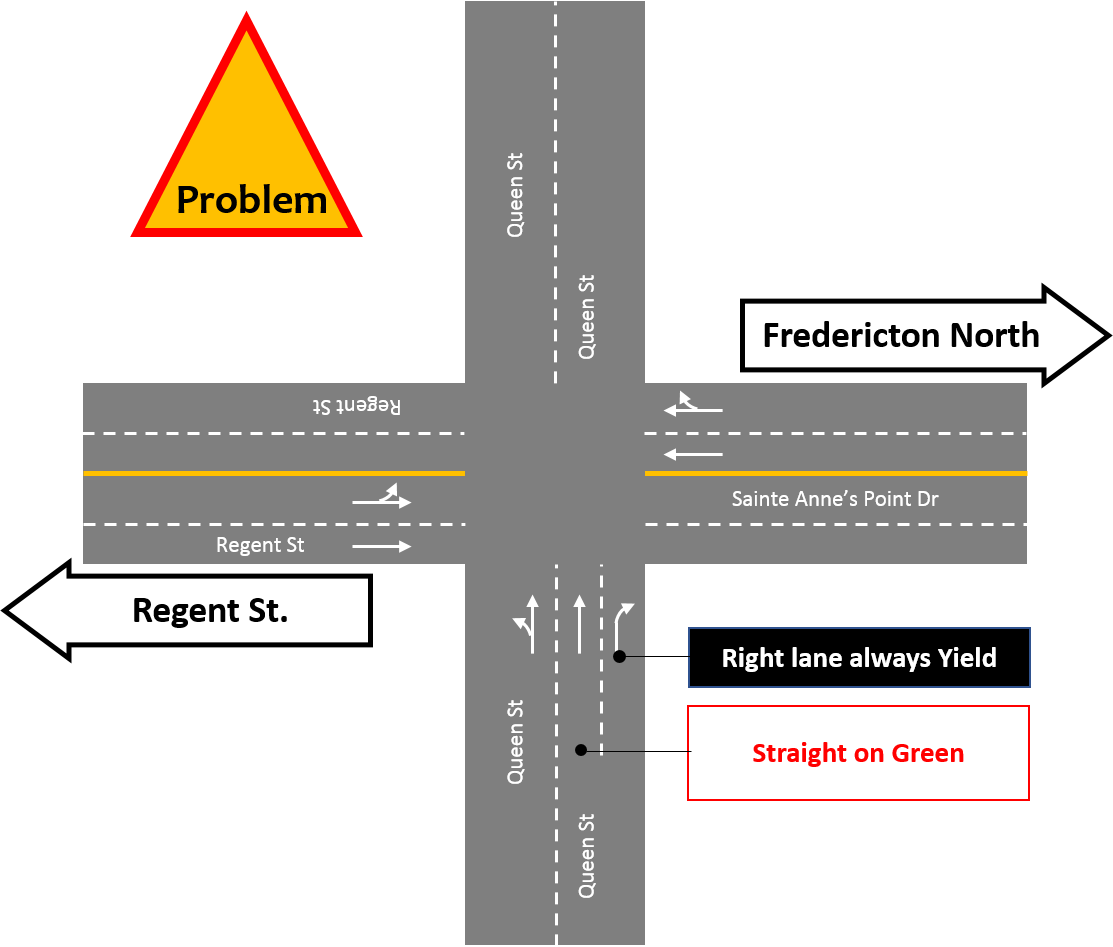
While travelling from South to North side via Westmoreland Downtown Bridge, I found that road lanes are not utilized to their full potential. There is room for improvement in traffic flow to North Side using Queen & Regent St. Rush time traffic is usually lined up on Queen St starting from Regent St to Kings College St (and beyond). Most of the lined up traffic is intended to go to North Side via Sainte Anne’s Point Dr (Figure 1). As there is only one right turning lane on Queen St merging to Sainte Anne’s Point Dr (to North Side), everyone has to wait in line on Queen St. for their turn to go right. Rush hour traffic to North Side is also high on Regent St which makes everyone turning right on Queen St. to wait indefinitely on the right turning lane because there is no room to merge on Sainte Anne’s Point Dr. When it is green on Queen St, only one lane is allowed to turn right while the second lane going straight is usually empty. 

The Solution 


A small change in traffic pa
ttern for right turning lanes on Queen St. can make a significant difference on traffic flow to North side via Sainte Anne’s Point Dr. to Westmoreland Bridge. By allowing Second lane to turn right on green on Queen St. will allow; 1) Right turning traffic on Queen St. to use both lanes on Sainte Anne’s Point Dr., 2). Zero interference with the Northbound traffic on Regent St as the second lane will turn right only when it is green. Right most lane on Queen St can always merge to the north bound traffic on Regent St and when it is green/red on Queen St. This change in traffic pattern might require it to move the traffic light pole situated close to Service Canada office and redesign the pedestrian crosswalk. This traffic pattern change will considerably reduce rush hour travel time from South to North Side and reduce the heavily lined up traffic on Queen St. 


Edited By: Heena Dhasmana

Cardiac regeneration using the hippo signalling pathway

Liver has the ability to regenerate, to overcome the damages caused by alcohol. Not many organs in body can do this, specially the human heart. Research suggest that heart does have the ability to regenerate, because there is something which is powerful and strong enough among ourselves, that is hippo. Heart attack causes irreversible damage to the heart and heart cell dies because they simply can’t breath and they never ever come back which leads to heart failure.

A novel mechanism focused on hippo pathway is a group of molecules work together to control the size of the heart and its growth, except it has a reversible action. In our young age, inner hippo pathways are inactivated, this is why our heart cells grows, expand and vibe. But due to some unknown reason and at some age, hippo pathways are activated. Same thing happens in the animals as well.

This means, we can use hippo pathways to bring back those cells which we thought were dead and gone. Using these cells, a fully functional heart can be created after the occurrence of heart attack. Researcher Kasif Khan in experimental surgical program at McGill University is working on the recreation of heart using hippo pathways.

Maintaining monogamy in committed romantic relationships

Show up your hand those you are currently in a relationship. Thank you

Now I would like you to imagine, or may be think back, when it was the last time, when you were at the party and your partner was not with you. Someone cute from across the room, lost eyes with you and smiled, and your heart flattens then oh no! what you doing in that situation, right? Now what previous research has taught us is that finding somebody else attractive when you are in a relationship is very common. But at the same time, our brains has a mechanisms to protect our relationships from outside threat. For example, we will try to rate the attractiveness of opposite sex is lower as compared to a single threats. We will also try to pay them less attention and even when we do pay them less attention, our recall of their attractiveness is actually less accurate as compared to our single threats and all of these are ways by which we protect our relationships from outside threats.

What happens if the outside threat is not a stranger at the party, no one has previously looked at if the the threat to your relationship is someone who is consistently in your life, or more long standing threat your relationship. And this is what I thought to find out. I asked over 750 adults about an experience of attraction they had while they were in a relationship and some of them not with partner, and the behaviour they engaged is fall into 3 broad categories. The first of which is practical points include things like I deleted this person from my phone. Enhancing the relationship, so for example I bought a present for my partner. The third of which is management threat, included behaviours like i told myself about negative consequences if i cheated on my partner.

And behaviours like these were endorsed by over 9 and 10 of my participants which indicates that majority of us are motivated and engaged and trying to protect our relationships from infidelity. What was even more interesting, were the people who use more of these behaviours compared to rest of samples. So I found out that those who are more sexually commissive, those who have more access, those who are more flirtatious towards opposite sex, and those who found themselves in episodes of receipt contraction i.e. the other person was also interested back, tended to use more of these behaviours than the rest of the sample.

And this shows that, there is sensitivity to the level of relationships threats that one can perceive and they amp up their efforts to protect their relationship likewise. This is very interesting that why should I know, what should I do with this information without monogamy elements? What we know that relationships are very important for our wellbeing. On the other hand, we also know that attractions to the people who are not our partners and infidelity by extension are quite common. By knowing more about how we protect our relationships, we can learn to better strengthen them, and increase our own wellbeing to the process.

Speaker, Brenda Lee is a student in the Department of Psychology at the University of New Brunswick Fredericton. Maintaining monogamy in committed romantic relationships won second prize of 3 Minute Thesis (3MT) Eastern Regional competition held at University of New Brunswick Fredericton on Apr 20th, 2017.